The two-hour limit I should have set myself
I have never set a screen time limit for any of my three daughters. This week a federal court set one anyway. Meta's settlement hands teens a two-hour cap and a midnight blackout, and my first reaction was not outrage but a relief.

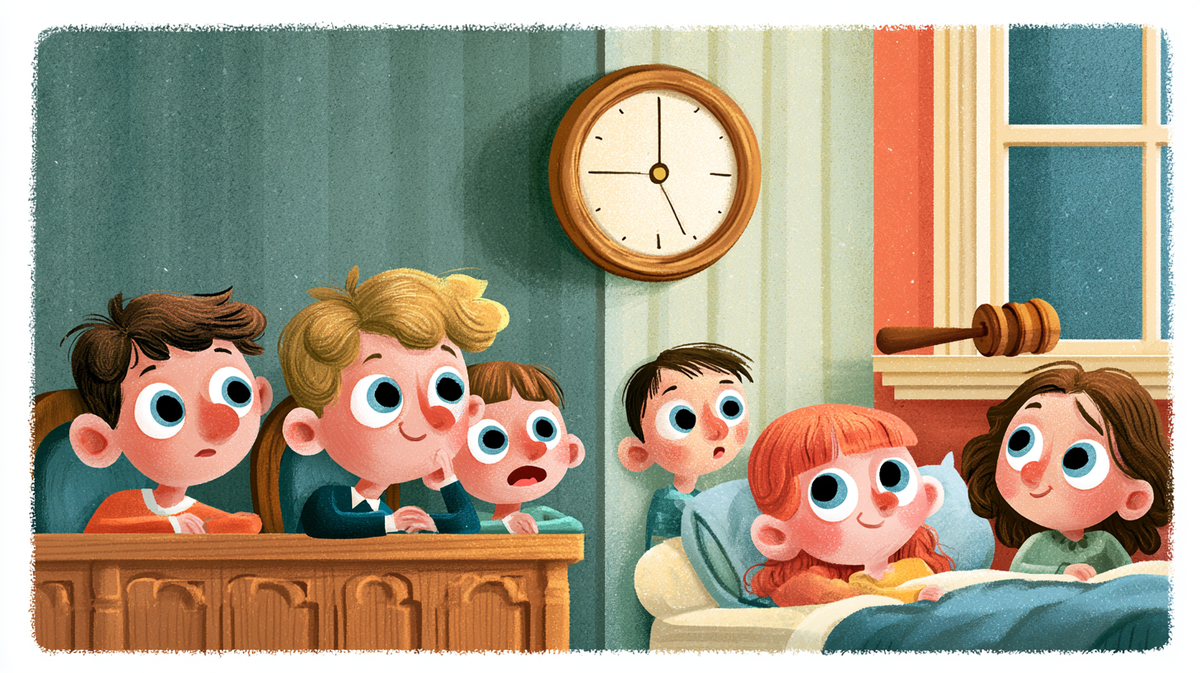
I have never set a screen time limit for any of my three daughters. Not once, not on any device, not for any app. The oldest is sixteen and the youngest is eleven, and somewhere along the way I decided that the interesting conversations in our house would be about what they post and who gets to see it, not about how many minutes they spend looking at it. We talk about public and private, about what belongs on a profile and what belongs in a group chat. We do not talk about minutes.
This week a federal judge in California was handed a document that sets those minutes for me.
What actually happened
On Wednesday, Meta agreed to settle the case that a bipartisan coalition of state attorneys general brought against it back in October 2023, in the middle of the second week of the trial in Oakland. The headline number is roughly eighteen billion dollars, but the number is not the interesting part, and I will come back to why.
The interesting part is the list of things Meta now has to do, by court order rather than by press release. Teenagers under eighteen get a combined two-hour daily limit across Facebook and Instagram, and that limit can only be changed with a parent's permission. The apps go dark between midnight and six in the morning, with an exception for direct messages, because apparently even a consent judgment understands that a teenager who cannot answer a friend at 1 a.m. will simply find another way. Push notifications stop during normal school hours. Like counts get hidden by default, certain appearance-altering filters get restricted, and teens will be nudged every fifteen minutes of continuous scrolling and again after an hour. An independent auditor, chosen by the states and Meta together, gets access to company data and reports to a committee of attorneys general. Most of it stays in force for ten years.
Meta admits no wrongdoing, which is the legal equivalent of apologising for how you were made to feel.

What the number really says
Eighteen billion dollars sounds like a company being punished. Sit with the structure for a minute and it starts to sound like something else.
About seventy percent of the total, roughly twelve and a half billion, gets paid out over the next ten years. That is a decade of instalments, not a bill. The remaining piece, a little over five billion, is conditional: Meta pays it only if YouTube and TikTok adopt similar or stricter settings, including an even tighter one-hour daily cap. And to help that along, Meta took out full-page ads in the Washington Post, the New York Times and the Los Angeles Times arguing that these settings should become the new industry standard.
Read that twice. A company that just settled a child-safety case is now spending money to lobby its competitors into the same rules, because five billion dollars of its own bill depends on whether they follow. It is not repentance. It is a company that lost a fight and is now trying to make sure nobody gets to keep competing on the thing it just gave up.
A company that lost a fight is now paying for ads to make sure nobody else gets to keep the advantage it surrendered.
Which is not nothing. I would rather have an industry standard imposed by a court than a set of good intentions announced at a developer conference. But the researchers who have studied this keep pointing at the same weak spot, and it is not the money. Almost nobody changes a default setting, and the two best items on the list, the non-algorithmic feed and switching off autoplay, are exactly the ones that require somebody to opt in. Everything the court could hard-wire is now hard-wired. Everything that needed a parent to actually go looking is still sitting there, waiting for a parent to actually go looking.
And, as one former Meta insider put it rather bluntly, if teenagers are simply using accounts that say they are twenty-three, all of it is worthless.
Panic is its own kind of laziness
The obvious way to read this week is that we were right all along, that the platforms knew, that our children were the product and now there is a court filing with a dollar sign to prove it. There is real satisfaction in that reading, and I felt it before I finished the first article.
But panic is its own kind of laziness. It lets you feel like you have done something when all you have done is have a feeling. Every time I have caught myself in that mode, worrying loudly at the dinner table about what these companies are doing to my daughters, I have noticed that the worrying takes up exactly the space that a real conversation would have taken, and costs considerably less.
The settlement is genuinely good news, and it is worth saying so plainly. Defaults matter enormously, more than rules do, because a default is the thing that happens when nobody is paying attention, and nobody is paying attention most of the time. My sixteen-year-old will lose the midnight-to-six window whether or not I ever mention it. She will get a screen telling her she has been scrolling for an hour whether or not I ever notice. That is a real improvement in her life, delivered without a single argument in my kitchen.
The trap is thinking that improvement was mine.
Where this gets uncomfortable for me
Here is the part I would rather not write.
I have told myself a decent story about why we do not do time limits in this house. The story goes that limits are a blunt instrument, that they teach kids to negotiate with a number instead of with themselves, that I would rather build judgment than build a fence. I still think most of that is true. I have also noticed that this story has the convenient property of requiring nothing from me on any given Tuesday evening.
A rule is work once. Judgment is work forever. I picked the one that sounds wiser and happens to be the one I can do from the couch.
And this week a courtroom did the thing I had decided was too blunt to do, for millions of children including mine, and my first reaction was not "how dare they". My first reaction was relief. Same as three weeks ago, when a bill promised me the transcripts. Same as two weeks ago, when OpenAI shipped a teen mode. Every single week of this series, somebody else has offered to carry a piece of my attention, and every single week I have noticed how badly I wanted to hand it over.
I do not think I am unusual in this. I think that is the whole business model.
And then there is my sixteen-year-old, who has set her own screen time limit. No family meeting, no negotiation, no input whatsoever from the two adults in this house who have spent years having opinions about screens. The number I refused to set on principle, and the number a federal court has now set on my behalf, is a number she had already arrived at on her own.
I would love to file that under parenting. I suspect it is just her.
A direction, not a system
I am not going to hand you a framework, partly because I do not have one and partly because the last thing either of us needs is another PDF. These are the things I want to try in the coming weeks, offered as a direction rather than a system.
Go and find the two settings the court could not force. The non-algorithmic feed and the autoplay switch are the only items on this whole list that change what your child sees rather than how long they see it, and both of them will sit there untouched forever unless somebody opens the menu. Do it once, this week, before the news cycle moves on and you forget it existed.
Ask, out loud, what a two-hour limit would even feel like. Not as a rule, as a question. I want to know whether my daughters experience two hours as generous or insulting, because the answer tells me something about their day that I currently do not know.
Watch what happens at midnight. The block is coming whether we like it or not, so the useful thing is to notice what moves into that space. If the answer is sleep, wonderful. If the answer is a different app that nobody has sued yet, that is worth knowing before it becomes a habit.
And say the quiet thing to them. My oldest is sixteen; she can handle "a court had to make a company stop doing something it knew was harmful, and I want you to know that is why the app changed, not because it got nicer." Kids who understand why a rule exists argue with it better, which is the point.
The line I'm keeping
The two-hour limit is not a parenting decision. It is a settlement term. It arrived through a federal court in Oakland, negotiated by attorneys general and lawyers and an independent auditor who will file reports for the next ten years, and it will land on my daughter's phone without anyone in this house being consulted.
I am glad it exists. I would also like to remember, when it arrives, that a limit is the cheapest thing a person can give a child. Anyone can set a number. The expensive part, the part no court can order and no company can ship, is being awake at the hour the number runs out.
Meta got court-ordered to be more careful with my daughters' attention than I have been with my own.
Sources
- TIME — 3 Big Questions After Meta's $18 Billion Teen Safety Settlement, 27 August 2026
- JURIST — Meta agrees to court-enforced limits on teen social media use in $18B settlements, 26 August 2026
- Bloomberg via Claims Journal — Meta Agrees to Pay Up to $16.7 Billion in Social Media Case, 26 August 2026
- Quartz — Meta settles multistate social media lawsuit for $16.7 billion, 26 August 2026
- CNN Business — Meta settles landmark state child harm claims for $18 billion, 26 August 2026
- Meta Newsroom — Agreement with state attorneys general supporting teens
- California Attorney General — Proposed consent judgment (PDF)
Raising kids in the AI age
This is part of the "Raising Kids in the AI Age" series. I'm a dad with three daughters, not an expert. I'm figuring this out as I go — and writing about it so you don't have to start from zero.
 Daniel Plomp
In this series
- The question we should stop asking our kids
- Your daughter's photo is one app away from being fake-naked
- Preparing children for a post-scarcity world
- Your kid trusts ChatGPT more than Google. That's a problem
- The AI conversations your kids are already having (And how to join them at dinner)
- Why banning ChatGPT from schools backfires
- What is bias in AI? A parent's guide to explaining fairness in algorithms
- AI Slop is destroying your kid's brain (and YouTube won't stop it)
- While you worried about screen time, your teen found something worse
- The 22% therapist
- Europe's answer walks into your kid's school on August 2
- The ad that pretends to be your friend
- Learn to think before you learn to prompt
- The talk we're not having
- The friend who never goes on holiday
- The answer machine your kid can't turn off
- The eleven-point gap
- America's answer comes with a key to your kid's diary
- OpenAI's answer grades its own homework
- The two-hour limit I should have set myself ← You are here