Learn to think before you learn to prompt
A Brookings researcher just gave the worry a name: cognitive stunting. Adults lose skills they once built. Kids risk never building them. But the fix isn't banning AI, it's protecting the struggle. A parent's take on what to teach before the prompting starts.

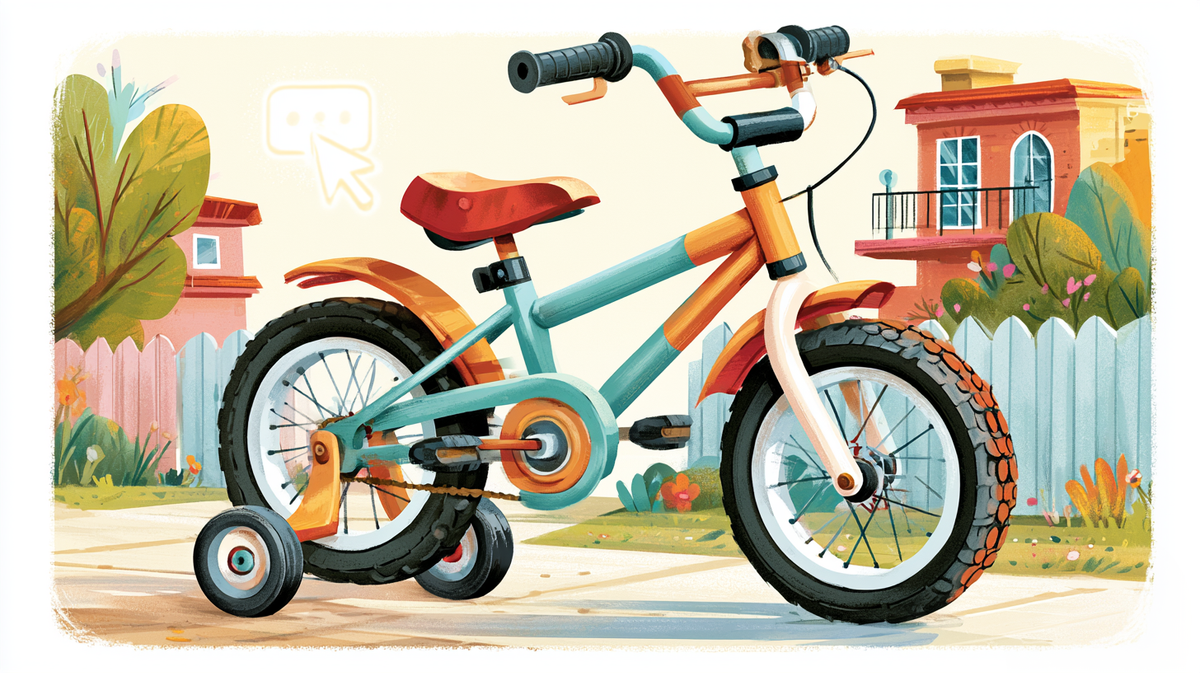
You cannot teach a kid to ride a bike by explaining it. I tried. I read out the steps, I held the saddle, I jogged alongside making encouraging noises. None of it transferred. The skill only arrived in the one moment I'd been trying to prevent: the wobble, the panic, the near-fall, the small correction the body makes on its own and never forgets. The struggle wasn't in the way of the learning. The struggle was the learning.
I keep coming back to that this week, because a researcher I follow gave a name to something I'd felt but couldn't quite say.
The word is "cognitive stunting"
In a piece published in May, Rebecca Winthrop of the Brookings Institution argued that we've been describing the risk of AI to kids with the wrong words. We say "cognitive offloading," or "cognitive decline." She thinks both miss it, and she proposes a blunter term: cognitive stunting.
The analogy is to physical stunting. Pediatricians have tracked children's height and weight against age norms since the 1970s. When a child doesn't get enough nutrition at the wrong moment, growth gets impaired, and the consequences can last a lifetime: lower stamina, academic struggles, reduced earning power down the road. Her question is whether something similar happens to a developing mind that stops getting enough of one specific nutrient. Effortful thinking.
Her line stuck with me: cognitive development, like learning to ride a bike, cannot be outsourced. You can't have a chatbot outline the steps and call it riding.
Why this isn't the same worry adults have
Here is the distinction that reframed the whole thing for me.
When I lean on AI to draft an email, I'm handing off a skill I already own. If the tool vanished tomorrow, the ability is still in me, a little rusty maybe, but there. That's offloading, and humans have done it since the wheel and the written word. It's mostly fine.
A child using AI to write the essay isn't offloading a skill they have. They're skipping the part where the skill gets built in the first place. Winthrop puts it plainly: kids are on the opposite side of the curve from adults. We're maintaining capacity. They're supposed to be growing it. The same shortcut that saves me twenty minutes can quietly remove the twenty minutes of struggle a twelve-year-old actually needed.
Adults lose skills to AI. Kids can fail to build them at all. Those are not the same problem, and we keep talking about them as if they were.
Where this gets uncomfortable for me
I should be honest, because this argument implicates me.
I use AI heavily at work, especially for programming. I don't hand-write much from scratch anymore. My instructions and my prompts have gotten good enough that I usually get the thing I would have built myself, in a fraction of the time. Most days I feel no real pull to do it the slow way, and the result holds up.
By the logic of this piece, that's probably fine. I already built the skill. The judgment, the sense of what good looks like, the instinct for when the machine is confidently wrong: I earned those the slow way, over years, and now I'm spending them rather than failing to grow them. That's the grown-up side of the line.
But I keep two questions close. The first is whether even earned skills quietly dull when you stop practising them, and whether the judgment that makes my prompting good would still form today if I were learning the craft now instead of fifteen years ago. The second matters more. The permission I give myself rests entirely on having done the work first, and my kids haven't. The shortcut I've earned is the exact shortcut I don't want them taking yet. So the line was never the tool. It's whether you built the thing yourself before you handed it off. I check which side of that line I'm standing on more often than I used to, and it turns out to be the same check I'm trying to teach them.
What the early evidence actually says
I want to be careful here, because this is a topic that invites panic, and panic is its own kind of laziness. The research is early and the honest summary is "concerning, not settled."
A few signals are worth knowing. One large study found heavier AI use linked to lower critical-thinking scores, with the effect strongest among younger users. Teachers are reporting a kind of "digital amnesia," where students can't recall the content of an assignment they turned in a day earlier. And a study that monitored brain activity during writing found lower neural engagement when people drafted with ChatGPT, along with weaker, more generic output.
None of this proves a generation is being hollowed out. It does suggest that the part of learning that feels like effort is the part that's doing the work, and that a tool optimized to remove effort deserves a careful eye when it's pointed at a still-forming brain.
The fork that keeps this from being doom
Here's the part the scary headlines skip. The same Brookings work that raised the alarm also found that AI, used narrowly and with guidance, can genuinely help kids learn. A review of dozens of studies came to the same place.
So the question isn't "AI or no AI." It's which kind of use. There's a real difference between a tool a teacher threads into a good lesson, and what Winthrop calls a "give-me-the-answer machine": a general chatbot a kid opens alone to make the work disappear. The first can add friction in useful places. The second removes the friction entirely, which is exactly the friction that builds the brain.
That reframing is oddly freeing. I don't have to keep AI away from my kids. I have to keep them on the right side of that line.
What I'm doing about it
A few household experiments, offered as a starting point rather than a verdict.
Let them be stuck first. The instinct is to rescue. I'm trying to let a hard problem sit for a while before any tool comes out, because the stuck feeling is the workout. Boredom and frustration aren't emergencies.
Make the AI ask, not tell. When a tool does come out, the rule is that it tutors, it doesn't answer. "Explain why my answer is wrong" builds something. "Give me the answer" spends it. Same tool, opposite effect.
Keep a few analog rooms. Some things stay by hand on purpose: a first draft, the early reading, mental arithmetic. Not out of nostalgia, but because those are the foundations everything else stacks on.
Narrate my own struggle. I let them see me stuck and working, not just me producing polished things at speed. The goal is for effort to look normal, even valuable, rather than like a problem AI exists to solve.
None of this is a system. It's a direction, and I expect to get it wrong in both directions before I get it right.
The line I'm keeping
Winthrop ends her piece with a sentence I've quietly adopted: children must learn to think before they learn to prompt.
That's the whole thing, really. Prompting is a skill, and a useful one, and my kids will need it. But it sits on top of an older skill, the one that comes from wobbling down the driveway with nobody pedaling for you. You can hand a child a lot of shortcuts. You can't hand them the ride.
Sources
- Rebecca Winthrop, "Is it time to measure cognitive stunting?" — Brookings, 2026-05-19: https://www.brookings.edu/articles/is-it-time-to-measure-cognitive-stunting/
- "A new direction for students in an AI world: Prosper, prepare, protect" (Brookings Global Task Force on AI in Education) — Brookings, 2026-01-14: https://www.brookings.edu/articles/a-new-direction-for-students-in-an-ai-world-prosper-prepare-protect/
- "Adults Lose Skills to AI. Children Never Build Them." — Psychology Today, 2026: https://www.psychologytoday.com/us/blog/the-algorithmic-mind/202603/adults-lose-skills-to-ai-children-never-build-them
- Jenny Anderson & Rebecca Winthrop, "Parents, your job has changed in the AI era" — NYT, 2025-09-11 (via Brookings): https://www.brookings.edu/articles/is-it-time-to-measure-cognitive-stunting/
Raising kids in the AI age
This is part of the "Raising Kids in the AI Age" series. I'm a dad with three daughters, not an expert. I'm figuring this out as I go — and writing about it so you don't have to start from zero.
 Daniel Plomp
In this series
- The question we should stop asking our kids
- Your daughter's photo is one app away from being fake-naked
- Preparing children for a post-scarcity world
- Your kid trusts ChatGPT more than Google. That's a problem
- The AI conversations your kids are already having (And how to join them at dinner)
- Why banning ChatGPT from schools backfires
- What is bias in AI? A parent's guide to explaining fairness in algorithms
- AI Slop is destroying your kid's brain (and YouTube won't stop it)
- While you worried about screen time, your teen found something worse
- The 22% therapist
- Europe's answer walks into your kid's school on August 2
- The ad that pretends to be your friend
- Learn to think before you learn to prompt ← You are here