The talk we're not having
Adults seem to have a hard time knowing which videos or reels are real or AI. I have to tell my mom it's fake a lot.

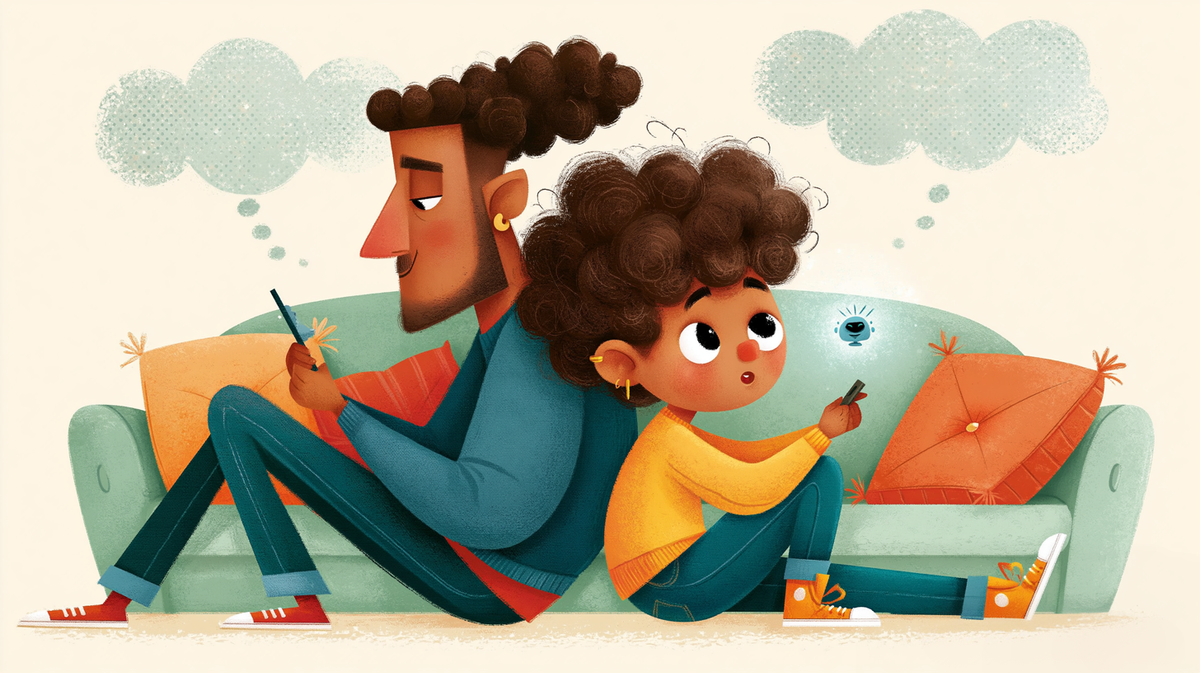
That's a kid, somewhere between 9 and 17 years old, answering an anonymous survey question about what adults don't understand about AI. Read it twice. We spend our parental energy worrying about whether our children can tell real from fake, and somewhere in America a kid is patiently doing media literacy triage for their mother.
I found that quote in a report that landed this Monday, and it's the reason this week's post exists.
Someone finally started counting
Last week I wrote about Rebecca Winthrop's question: shouldn't we measure cognitive stunting the way pediatricians have measured physical growth since the 1970s? Height, weight, age norms, a chart on the wall.
This week, someone picked up a pencil.
On June 8, Common Sense Media published the first Common Sense Media Census: AI Use by Tweens and Teens. The setup: 1,204 kids ages 9 to 17 across the US, surveyed in March, answering for themselves rather than through their parents. It's explicitly designed as a baseline: they plan to repeat it every year, the same way you mark a doorframe and come back to it.
That makes it the first real growth chart for this generation's relationship with AI. And like any first measurement, the value isn't in the panic it can fuel. It's in what it tells us to pay attention to.
What the numbers actually say
The headline number is the least interesting one: 86% of kids ages 9 to 17 use AI. Of course they do. A quarter of them use it daily.
The interesting numbers are underneath.
AI doesn't arrive through the front door. The most common form of AI in kids' lives isn't ChatGPT. It's the AI summary at the top of a Google search, used by 75% of kids. Your child can be a daily AI user without ever opening a chatbot. "My kid doesn't use ChatGPT" turns out to be a sentence that comforts the parent and describes nothing.
It stopped being a homework machine a while ago. Among kids who use AI, 89% use it for fun and 85% for schoolwork. But 57% have asked it about their health or body, 40% use it to practice conversations and social skills, and 37% have discussed feelings or personal problems with it. Twelve percent of all kids would take a health question to a chatbot before any adult. Among daily users, that's 27%.
And the trust is misplaced. Only 35% of kids know that AI cannot reliably tell true from false; 42% believe it can. Here's the detail that stung: kids who say they know "a lot" about AI barely do better, at 37%. Confidence isn't literacy. (If this sounds familiar: I wrote about exactly this gap in "Your kid trusts ChatGPT more than Google.")
The two silences
But the number the whole report quietly orbits is this one: 44% of kids say no parent or guardian has ever talked with them about how to use AI safely.
Not "talked about AI." Talked about using it safely. Even among kids who use AI every single day, a third have never had that conversation.
And there's a second silence stacked on top of the first. Seventeen percent of kids who use chatbots say one has shown or told them something that "wasn't okay or wasn't meant for someone your age." Of those kids, 53% never told an adult.
Sit with that combination for a second. We're not talking, and so they're not telling. Silence travels in both directions, and it compounds.
Schools aren't closing the gap either. Almost three-quarters of kids say their school told them what they can and can't use AI for: the rules. Only about half were taught how to check whether what AI tells them is accurate. We've taught them not to cheat with it before teaching them not to believe it.
Before we panic
I keep a rule in this series: the scary number never gets the last word, because panic is its own kind of laziness.
So, the counterweights. Seventy-seven percent of kids say that when they have a question, they usually try to solve it themselves before asking AI. The kids are not, in fact, outsourcing their brains wholesale. And yes, daily AI users report more loneliness than non-users (54% vs. 33% feel lonely at least some of the time). But the report itself says plainly that a single survey can't tell you whether AI use makes kids lonely or lonely kids reach for AI. Both arrows probably exist. There's even a hopeful detail hiding in the sad corner: of the kids who discussed their feelings with a chatbot, 39% say it pointed them toward real mental health support.
This is a census, not a verdict. But a census is exactly what you want before the verdict: it tells you where to look.
Where this gets uncomfortable for me
Here's my confession for this week.
If you'd asked me whether I talk with my kids about AI, I'd have said: constantly. It's my work. It's at our dinner table the way football is at other tables. My daughters have heard me explain hallucinations, deepfakes, the whole bestiary. Most of it has ended up in this series.
But the census question isn't "have you talked about AI." It's "has a parent talked with you about how to use AI safely." And when I held myself to that wording, I got less sure. Talking about AI a lot is an excellent way to feel like you've had the talk without ever actually having it. It's ambient knowledge, not a conversation. The cobbler's children go barefoot; the AI consultant's children get lectures about Brookings reports and no actual safety talk.
So before writing this, I did the only honest thing available: I asked them the census questions. I'll keep what was said at our table at our table, but I'll tell you it was not the conversation I would have predicted. That's rather the point.
What I'm doing about it
Four experiments, in the spirit of the series: a direction, not a system.
Have the talk as a quiz, not a lecture. The census hands you three perfect questions: Does AI learn from what you tell it? Can AI tell the difference between true and false? Is AI responsible for what it says? (True, false, false.) Ask them cold, let them argue, then look up the answers together. Ten minutes, and you've covered more than half the kids in the survey ever got.
Audit the access points. AI now lives inside search, inside school laptops, inside social apps. We're walking through it together: which apps have it, which get to stay. The report's advice is to decide this with your kid, not for them, and that matches my experience: rules they co-author survive contact with reality longer.
Make "tell me when it gets weird" the family norm. That 53% who never told an adult is the number I most want to move. So the standing offer in our house: if AI ever shows you something that feels off, you can bring it to me and the first response will never be punishment or panic. You can't be the safe adult and the scary consequence at the same time.
Mark the doorframe yearly. Common Sense will re-run the census every year. So will we, at home. Same questions, every year: what are you using, what do you ask it, what would you ask it that you wouldn't ask me? The answers will change. That's what growth charts are for.
The line I'm keeping
We rehearse the other "talk", the birds and the bees, for years before we dare to have it. We dread it, we plan it, we get books about it. This one we're mostly just... skipping. Not out of neglect, but because the technology moved faster than the dinner conversation.
The census doesn't say we've failed. It says we're late. Forty-four percent of the talks are still waiting to happen, and unlike most numbers in this series, that one is entirely within our power to change by Sunday evening.
Have the talk. Then have it again next year.
Raising kids in the AI age
This is part of the "Raising Kids in the AI Age" series. I'm a dad with three daughters, not an expert. I'm figuring this out as I go — and writing about it so you don't have to start from zero.
 Daniel Plomp
In this series
- The question we should stop asking our kids
- Your daughter's photo is one app away from being fake-naked
- Preparing children for a post-scarcity world
- Your kid trusts ChatGPT more than Google. That's a problem
- The AI conversations your kids are already having (And how to join them at dinner)
- Why banning ChatGPT from schools backfires
- What is bias in AI? A parent's guide to explaining fairness in algorithms
- AI Slop is destroying your kid's brain (and YouTube won't stop it)
- While you worried about screen time, your teen found something worse
- The 22% therapist
- Europe's answer walks into your kid's school on August 2
- The ad that pretends to be your friend
- Learn to think before you learn to prompt
- The talk we're not having ← You are here