The AI conversations your kids are already having (And how to join them at dinner)
Your teenager just turned in a history essay that sounds suspiciously sophisticated. Your middle schooler created digital art that looks professionally polished and won't quite explain how. If you're wondering whether your kids are using AI tools, here's the uncomfortable truth: they are.


While you, like many parents, may still be figuring out what to think about ChatGPT, they've been navigating complex ethical questions about AI assistance that most adults haven't even considered.
The solution isn't more restrictions. It's better conversations.
Before you start: reflect on your own AI use
Before initiating any of these conversations, take a moment to examine your own relationship with AI. Do you use autocomplete, smart replies, navigation apps, or recommendation algorithms? Have you ever asked a chatbot a question out of curiosity?
Ask yourself:
- Which AI tools do I use daily, maybe without realizing it?
- How do I decide when to trust AI-generated information?
- What assumptions do I bring about my kids' AI use — curiosity, concern, suspicion?
Being honest about your own habits prevents the conversations below from feeling like an interrogation and models the self-reflection you're asking of your kids. It also aligns with the spirit of this guide: exploring AI together, not policing it from above.
Why dinner table AI talks matter right now
According to a 2023 survey by the Pew Research Center, a 1 out of 5 U.S. teens aged 13–17 have used generative AI tools such as ChatGPT, while a Common Sense Media report (2024) found that most parents had not yet discussed AI boundaries with their children. This gap leaves kids making ethical decisions about AI use without adult guidance, often learning AI "rules" from peers rather than family values.
Your kids want to talk about this stuff. They're facing genuine dilemmas about when AI help crosses ethical lines, how to maintain creativity when AI can generate anything, and what skills they need to develop in an AI world. These are exactly the kinds of meaningful conversations that strengthen family relationships and develop critical thinking.
You don't need to become an AI expert to facilitate these discussions. You just need to start asking the right questions. The five conversation types below are ordered roughly from concrete and everyday to more abstract and forward-looking. Use the age-group suggestions as starting points: younger children (roughly 10–12) benefit most from hands-on, concrete conversations, while older teens (16–18) are ready for nuanced ethical and future-oriented discussions. That said, you know your child best — feel free to adapt.
1. The homework helper talk
Best starting point for ages 10–15; relevant for all ages

Your kids already know the difference between asking AI to do their homework and asking it to help them understand concepts. They're making judgment calls about this daily.
Start here: "I've been wondering—if you were stuck on a math problem and asked an AI to explain the steps versus asking it to just give you the answer, what's the difference to you?"
Tailor the question to your child's age.
For younger kids (10-12): "If a robot did your book report for you, would it still feel like yours? Why or why not?"
Middle schoolers (13-15) might respond better to: "Have you ever been unsure if using AI for an assignment was okay? What did you decide?"
High schoolers (16-18) can handle: "Where do you draw the line between AI-assisted research and letting AI do the thinking for you?"
Follow up with questions like: Have you ever been in a situation where you weren't sure if using AI was okay? What would you do if a teacher said 'no AI' but you genuinely needed help understanding something? How is using AI for homework different from using a calculator or spell-check?
Instead of setting rigid rules, you're exploring the ethical reasoning your kids are already developing. This approach helps them articulate their own boundaries while benefiting from your perspective.
After the conversation — possible next steps:
- Agree together on a family "homework & AI" guideline (e.g., "AI can explain, but I write the final answer myself").
- Decide when your child will check with a teacher if they're unsure about AI use.
- Revisit the guideline after a month to see if it still fits.
2. The creative collaboration discussion
Engaging for all ages; especially rich for ages 12–18
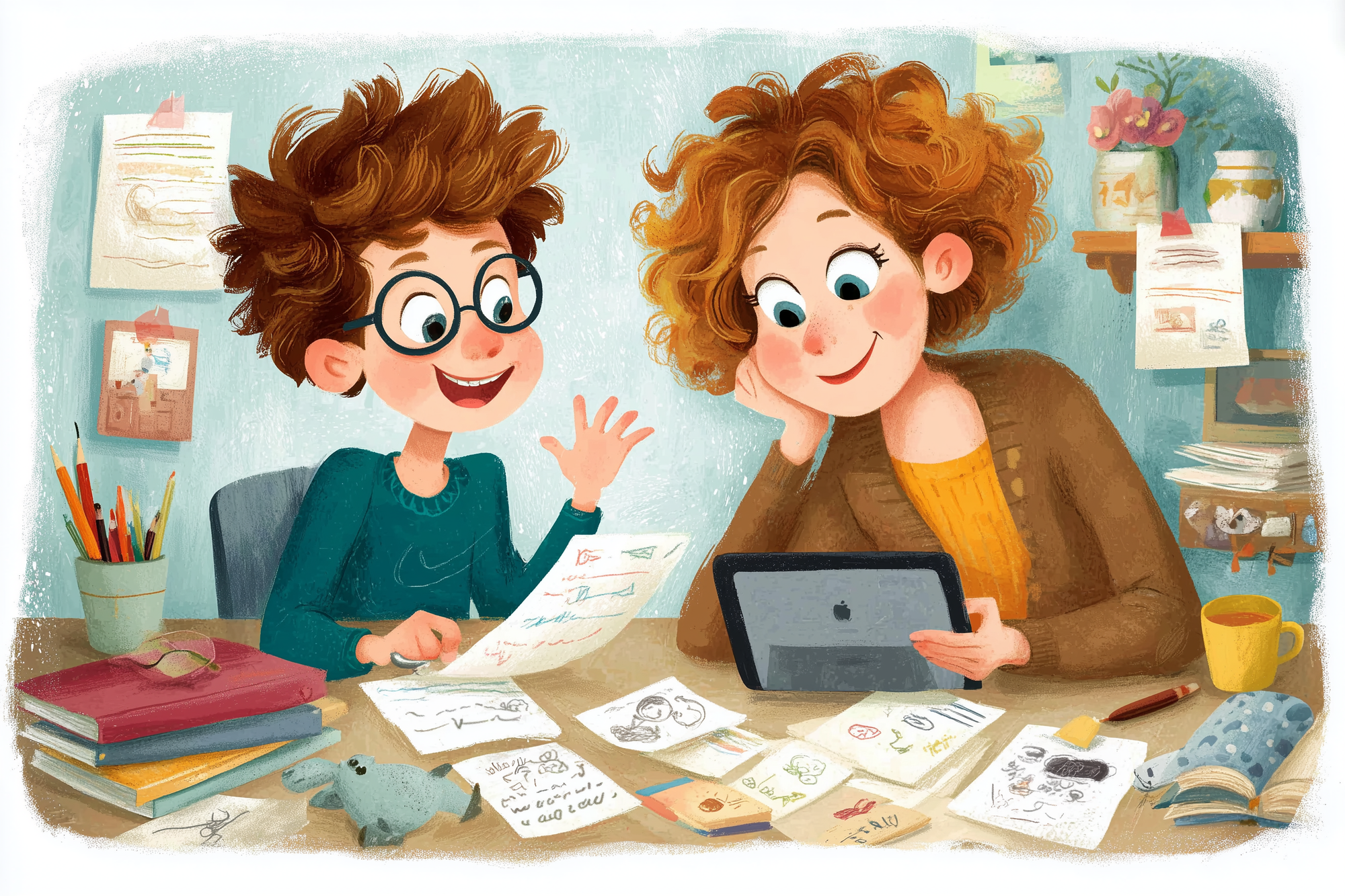
Kids are using AI for creative projects — art, writing, music composition. They're wrestling with questions about authenticity and creativity that professional artists are still debating.
Try this: "Show me something creative you've worked on recently. Walk me through your process—what parts did you do, and what tools did you use?"
With younger kids (10-12), you might ask: "If you asked an AI to draw a picture and then colored it in yourself, who made the art?"
Middle schoolers (13-15) can explore: "What's the difference between using AI for inspiration and letting it do the creative work?"
Older teens (16-18) are ready for: "If you submit AI-assisted work to a contest or portfolio, how should you disclose that?"
This naturally leads to important questions about creative ownership: When you use AI to help with creative projects, how do you make sure it's still 'yours'? What's the difference between AI giving you ideas and AI doing the creative work? If you submitted AI-assisted art to a contest, how would you want that labeled?
Positioning yourself as genuinely interested in their creative process rather than suspicious of their methods helps kids develop their own standards for authentic creative collaboration.
After the conversation — possible next steps:
- Create something together using AI as a tool (e.g., generate a story prompt and write the story yourselves).
- Agree on a personal "credit label" your child feels comfortable with when sharing AI-assisted work.
- Explore one new creative AI tool together and discuss what it does well and what it doesn't.
3. The fact-checker challenge
Great hands-on starting point for ages 10–12; valuable for all ages
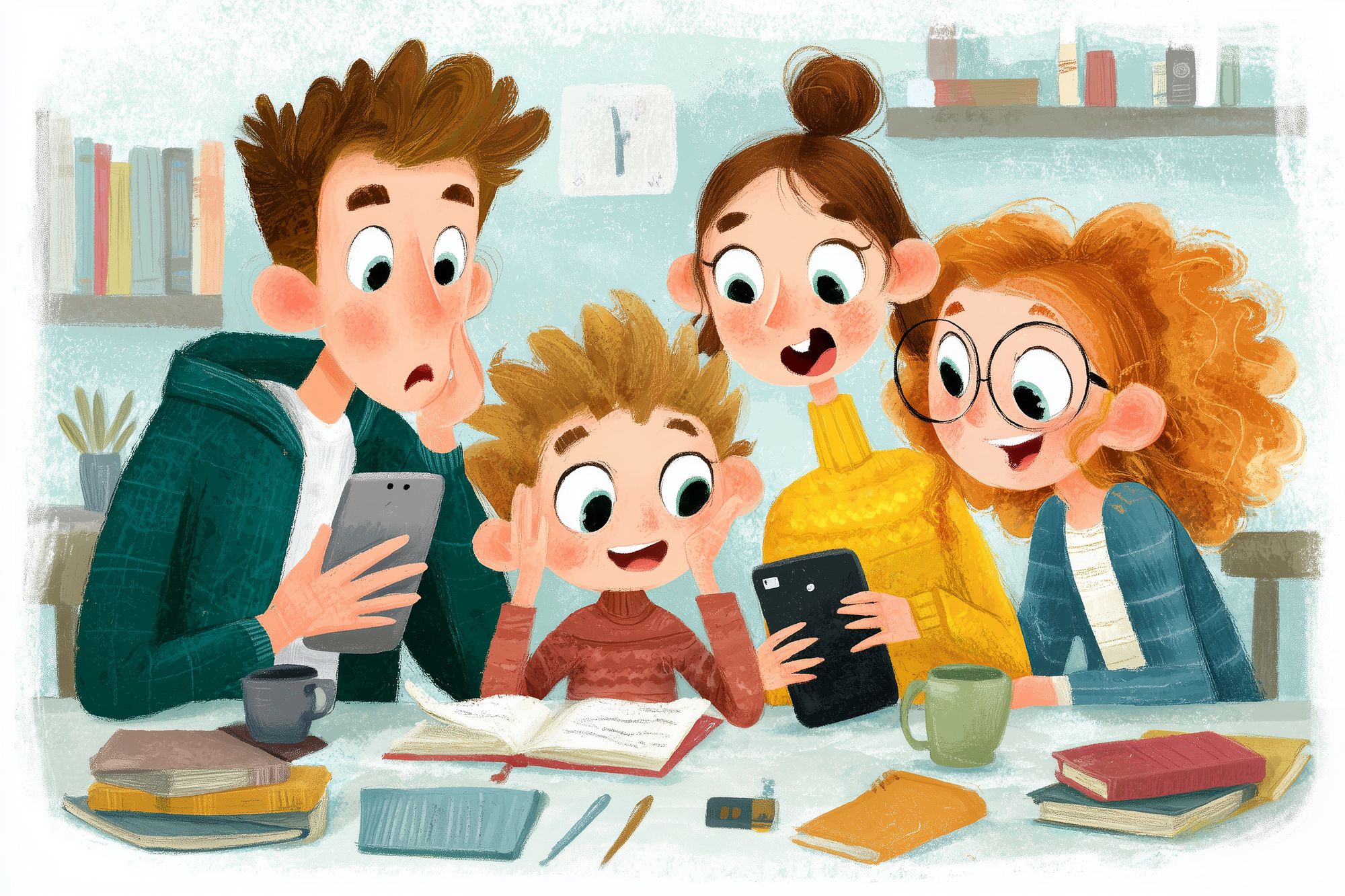
Kids need to learn that AI can confidently present false information. But lectures about "AI hallucinations" are less effective than hands-on experience spotting inaccuracies.
Try this step-by-step activity:
- Step 1 — Pick your topics
Everyone chooses a subject they know well: a favorite band, a sport, a historical event, a hobby. - Step 2 — Ask the AI
Each person asks a chatbot (such as ChatGPT or Copilot) three specific factual questions about their topic. For example: "What awards has Nikola Jokić won in the NBA?" - Step 3 — Check the answers
Compare the AI's responses against a reliable source (an official website, a trusted encyclopedia, a book you own). Highlight anything that looks wrong or made up. - Step 4 — Share your findings
Go around the table. What did the AI get right? Where did it confidently present something false?
Example outcome: When one family tried this, ChatGPT claimed a basketball player had won "NBA Defensive Player of the Year," an award the player had never received. The AI stated it with complete confidence. That moment of surprise was worth more than any warning a parent could give. - Step 5 — Discuss together
- How could you tell when the AI got something wrong?
- What would you do if AI gave you information for a school report that you weren't sure about?
- Who in our family is good at fact-checking different types of information?
Making AI fact-checking a family activity removes the pressure and makes it collaborative learning.
After the conversation — possible next steps:
- Agree on a "verify before you cite" rule for school assignments.
- Bookmark two or three reliable fact-checking sources together (e.g., a library database, Snopes, an official statistics site).
- Challenge each other to a monthly "catch the AI" round to keep skills sharp.
4. The peer pressure scenario
Especially important for ages 13–16, when social dynamics around AI use are most intense

Your kids are navigating social dynamics around AI use. Some classmates use it extensively, others avoid it entirely, and teachers have varying policies. This creates genuine social pressure.
Start with their reality: "Are your friends using AI for school stuff? How do you handle it when some people are using AI and others aren't?"
Younger kids (10-12) might respond to: "If a classmate said 'everyone uses AI for homework,' what would you think?"
Middle schoolers (13-15): "Have you ever felt pressure to use AI because others were, or pressure not to because others weren't?"
High schoolers (16-18): "How do you think schools should handle the fact that students have very different AI access and skills?"
Follow up: What would you do if you knew a friend was using AI in a way that seemed unfair? How do you think your class should handle everyone having different AI access and skills?
These questions help kids think through peer situations before they arise and reinforce that they can come to you with social dilemmas.
After the conversation — possible next steps:
- Role-play a tricky scenario (e.g., a friend asks to copy your AI-generated work) and practice possible responses.
- Agree that your child can always come to you without judgment when facing an AI-related social dilemma.
- Check in with your child's school about their current AI policy so you can navigate grey areas together.
5. The future skills conversation
Most engaging for ages 14–18; can be simplified for younger children
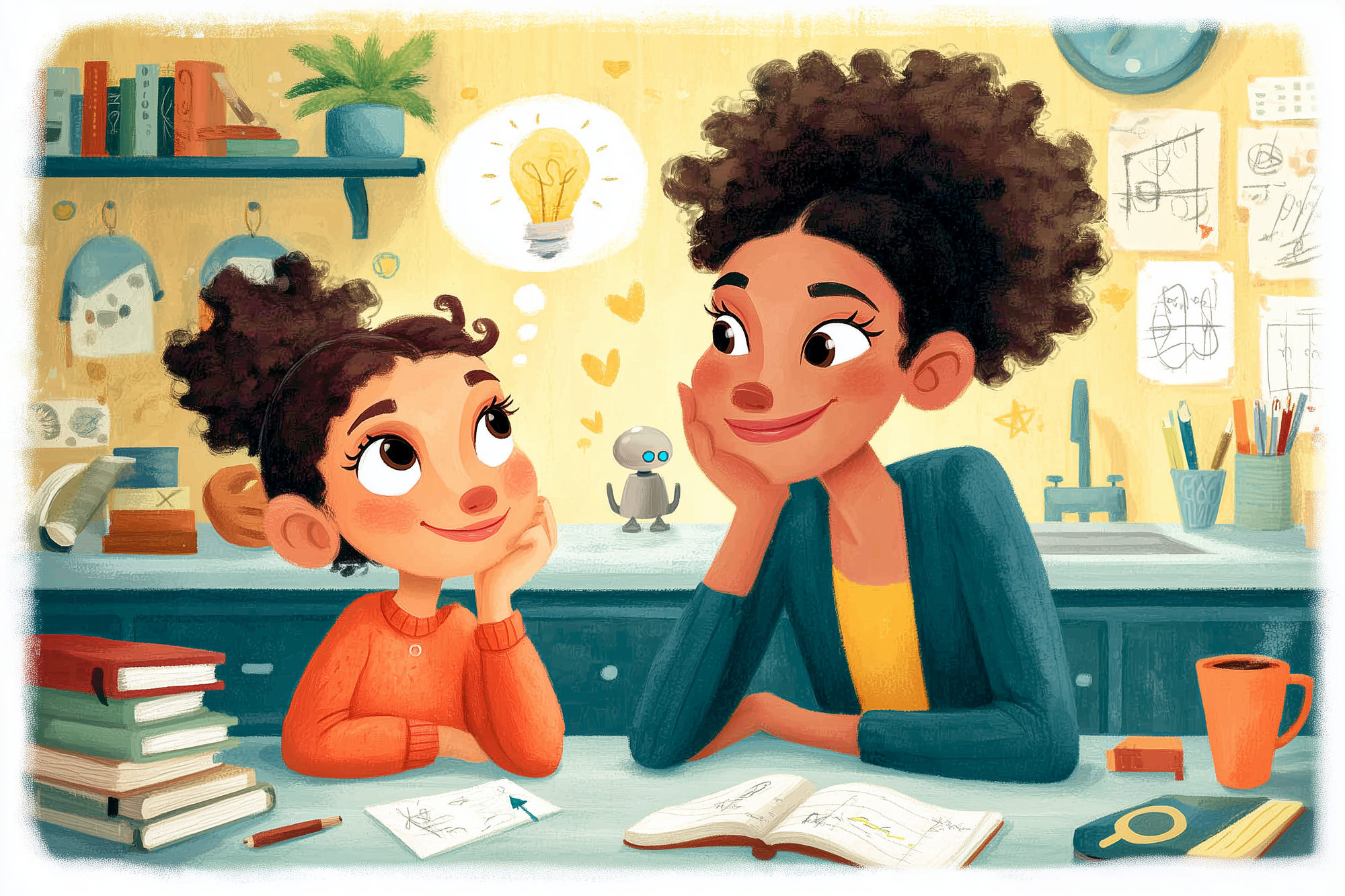
Kids are worried about AI replacing human abilities, but they need help identifying which skills become more valuable, not less, in an AI world.
Ask them to think ahead: "If AI can write essays and solve math problems, what do you think are the most important things for humans to be really good at?"
With younger kids (10-12): "What's something you can do that a robot probably can't?"
Middle schoolers (13-15): "What skills do you want to develop that would still matter even if AI gets really advanced?"
High schoolers (16-18): "How might AI change the career or field you're interested in, and how could you prepare for that?"
Continue with: What's something you're naturally good at that you don't think AI could replicate? How do you think AI might actually help you get better at things you care about?
This approach is fundamentally optimistic and forward-looking. It helps kids see AI as a tool that can amplify their unique human abilities rather than replace them.
After the conversation — possible next steps:
- Have your child identify one "uniquely human" skill they want to strengthen this semester (e.g., public speaking, empathy, creative problem-solving).
- Explore together how AI could support that skill rather than replace it.
- Revisit the conversation in six months to see how their thinking has evolved.
Making these conversations stick
The key to successful AI conversations is treating them as ongoing discussions, not one-time talks. You might try a brief weekly check-in at dinner, in the car, or whenever your family naturally talks ("Anything interesting happen with AI this week?"), longer conversations when relevant news breaks or school policies change, and hands-on sessions every month or so where you explore a new AI tool together.
Research in digital media literacy consistently highlights the value of exploring technology alongside your kids rather than setting rules from the sideline. The Joan Ganz Cooney Center’s work on joint media engagement suggests that children learn more from technology when adults actively participate with them, ask questions, and discuss the experience, rather than only supervise. You don't need to become an expert, but experimenting together builds understanding and trust.
The conversation continues
Your kids are already living in an AI world, making daily decisions about when and how to use these powerful tools. These conversations, whether at the dinner table, in the car, or on a walk, won't resolve all the complex questions around AI and education. But they will ensure your kids know they can bring their real AI dilemmas to you, that your family's values guide their AI choices, and that they're developing the critical thinking skills to navigate an increasingly AI-integrated world.
At your next family moment together, pick one conversation from this list, whichever feels most natural for your child's age and your family's situation, and simply ask the opening question. Then listen. The rest will follow.
Raising kids in the AI age
This is part of the "Raising Kids in the AI Age" series. I'm a dad with three daughters, not an expert. I'm figuring this out as I go — and writing about it so you don't have to start from zero.
 Daniel Plomp
In this series
- The question we should stop asking our kids
- Your daughter's photo is one app away from being fake-naked
- Preparing children for a post-scarcity world
- Your kid trusts ChatGPT more than Google. That's a problem
- The AI conversations your kids are already having (And how to join them at dinner) ← You are here