When your job talks back
How AI agents are quietly changing the way we work.

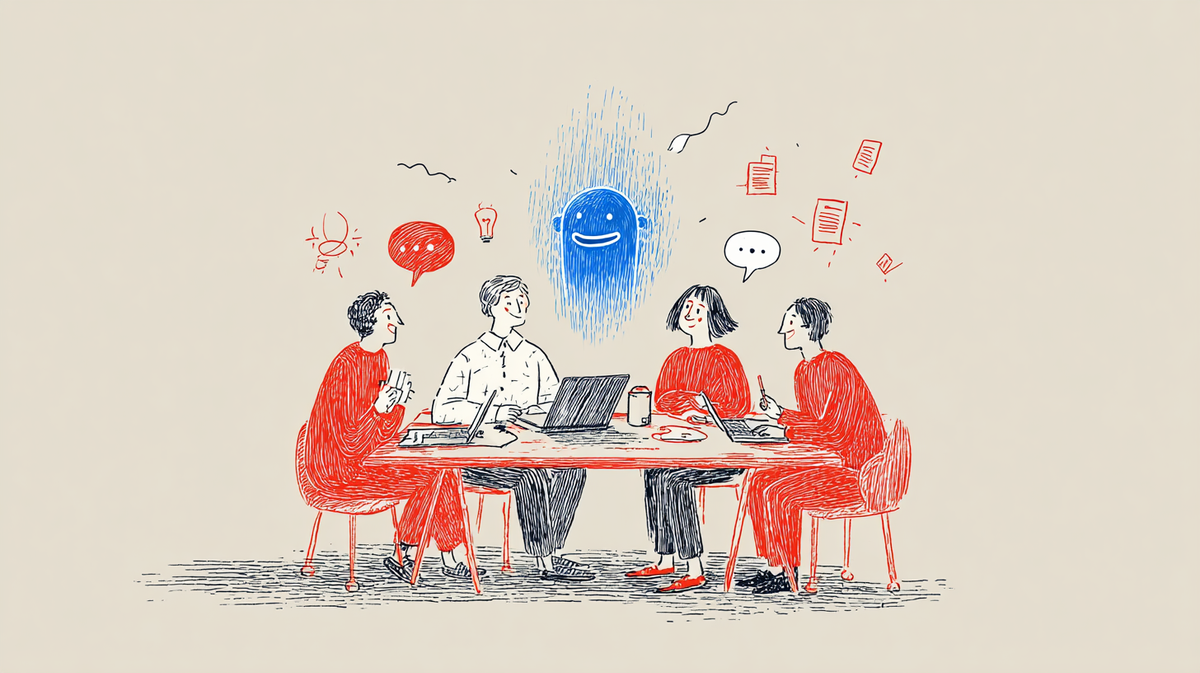
Recently, I watched a colleague have a genuine argument with their expense reporting system. Not the old kind of argument where you curse at unresponsive software, but an actual conversation. The AI agent kept asking clarifying questions about receipts, my colleague kept explaining context, and somehow they worked it out together.
It was weird. And it was the future.
The invisible revolution
We're in the middle of something big, but it's happening so gradually that most people haven't noticed. Software isn't just getting smarter—it's getting conversational. And that changes everything about how work gets done.
Having spent years building enterprise software, I've seen the goal evolve. In the early 2010s, we aimed to make interfaces so intuitive that users wouldn't need training. Now? The goal is to make software that can be trained by users.
The difference isn't subtle. It's the difference between a microwave and a personal chef.
When tools become coworkers
In my own work, I find myself writing code by describing what I want and letting the AI figure out the implementation. The weird part? I've started talking to it like a coworker I'm pair-programming with. "Make this more secure" or "This feels overengineered, simplify it."
My AI assistant reads industry reports while I sleep and summarizes them over coffee. It's like having a research partner who never gets tired and actually enjoys reading whitepapers. When I'm planning business moves, I bounce ideas off an AI that knows my company's finances better than I do. It asks tough questions I hadn't thought of and suggests approaches I wouldn't have considered.
The breakthrough isn't that these tasks get automated—it's that they become collaborative.
When AI becomes your coworker, what you pay for changes too
Meanwhile, something else is happening. As AI shifts from passive tool to active collaborator, the business model that built the software industry is quietly falling apart.
Software as a service meant paying monthly for access to tools you might use occasionally. Developers loved it because it meant predictable revenue. Users tolerated it because, well, what choice did they have?
But AI agents don't follow subscription logic. Why pay $50/month for accounting software when an agent can handle your books for the cost of a few API calls? Why maintain seat licenses when the work gets done regardless of who's technically "using" the software?
I'm seeing companies experiment with outcome-based pricing. Pay for results, not access. $0.99 for each customer support ticket resolved by AI. Sales tools that calculate commissions when deals close. Project-based consulting where the consultant happens to be an algorithm.
It feels like we're headed toward a world where software acts more like freelance work than recurring infrastructure.
The human skills that matter more
This shift reveals something interesting about what humans are actually good at.
In my experience running a small business, the valuable work has never been the mechanical stuff—processing receipts, formatting reports, updating spreadsheets. The value was always in the decisions between those tasks. Should we pursue this client? Is this expense worth the hassle? How do we present this data to make our case?
AI handles the busywork brilliantly, but it can't make judgment calls about your specific situation. It doesn't know that your biggest client hates detailed invoices or that your team works better with deadlines than open-ended projects.
The companies adapting well to AI aren't the ones replacing humans with machines. They're the ones figuring out how to amplify human judgment with machine efficiency.
What this means for normal people
If you're not a developer, you might think this AI agent stuff doesn't apply to you. That's probably wrong.
Your accountant is already using AI to process tax returns faster. Your doctor's office uses AI to schedule appointments and handle insurance preauthorizations. Your kid's teacher uses AI to generate personalized reading assignments.
The change isn't coming—it's here. But unlike previous waves of automation that eliminated jobs, this wave seems to be eliminating busywork while creating space for more interesting problems.
I know a marketing consultant who used to spend half her time on campaign analysis. Now AI does that overnight, so she spends her time on strategy and client relationships. A project manager friend automated his status reporting, which freed him up to focus on anticipating problems before they happen.
The pattern seems to be: AI takes the predictable work, humans handle the exceptions and relationships.
The messy middle
We're still figuring this out, and it shows.
Some AI agents are impressive. Others are expensive ways to get confident wrong answers. Some companies are saving money on software subscriptions. Others are burning cash on AI experiments that don't quite work yet.
The winners seem to be the ones treating AI as a thinking partner rather than a replacement employee. They're not asking "How can AI do my job?" but "How can AI help me do my job better?"
That's a much more interesting question. And the answers are just getting started. Next time you catch yourself talking to your tools instead of just using them, pay attention—because how you navigate that conversation might be the most important professional skill of the next decade.
In this series
This post is part of the Disruptive AI series.
 Daniel Plomp
- I watched a developer admit AI killed his business model. Here's why I'm not worried.
- I'm Living the AI Disruption Everyone's Warning About
- The hidden signs you're addicted to AI and why it's different
- The AI productivity trap: why your brain can't keep up with your tools
- When your job talks back (this post)

I'm a developer who went from .NET to Laravel to building with AI agents full-time. I write about what actually works — and what doesn't.
Get my weekly takes on vibe coding, AI-assisted development, and building products as a solo maker.