The rise of the generative CMS: what it is, why it matters, and how it changes digital experience forever
A Generative CMS goes beyond traditional content management by combining verified retrieval, real-time adaptation, brand guardrails and dynamic assembly. It shifts digital experience from static pages to intelligent, contextual interactions.

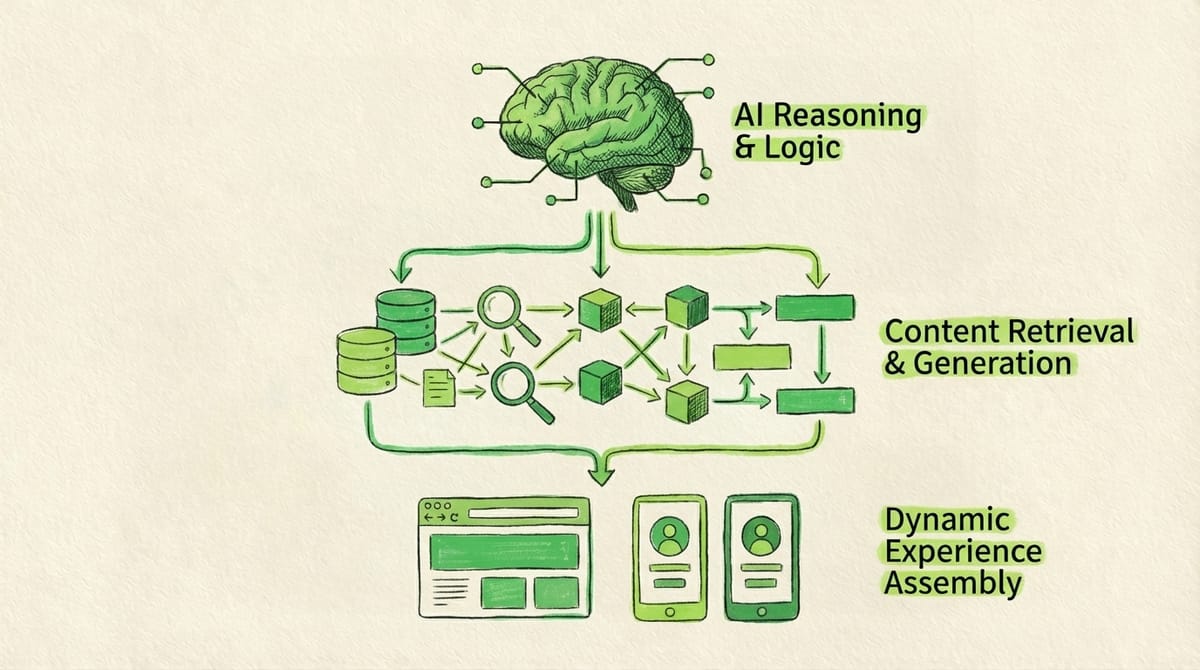
Digital experiences are evolving faster than traditional CMS platforms can support. Users no longer want to navigate deep menu structures or browse static pages. They expect instantly relevant answers, contextual assistance, and interactions that feel more like a conversation than a search query.
That shift marks the emergence of a new category: the Generative CMS.
Where older systems focus on managing content, a Generative CMS focuses on understanding, retrieving, reasoning, and generating digital experiences dynamically.
This article explores the core ideas behind this new model, what defines a Generative CMS, and why organizations are moving in this direction.
Traditional CMS platforms are reaching their limits
Classic web content management has always been page-centric. Content is authored, stored, published, and displayed in predefined structures. Personalization is usually rule-based and requires manual variants or complex workflows.
But user expectations have changed:
- They want immediate answers, not navigation.
- They want information in the context of their intent.
- They want conversational, natural responses.
Legacy CMS systems weren’t designed for this level of adaptiveness or reasoning. They deliver content — not intelligence.
A Generative CMS fills that gap.
What defines a Generative CMS
A Generative CMS is not just a CMS with AI bolted on top. It requires a deeper architectural shift. Below are the key capabilities that characterise such a platform.
1. Dynamic experience assembly
Instead of predefined page variations, experiences are assembled in real time. Layout, messaging, and content blocks adapt automatically based on context, goals, and user behavior.
2. Real-time adaptation
Traditional segmentation is coarse and slow. A Generative CMS adapts instantly as users interact with content — at the level of intent, not just demographics.
3. Retrieval-augmented generation (RAG)
A key principle: content isn’t generated from a vacuum.
Instead, the system retrieves verified, trusted information from internal repositories and uses that as the factual basis for generated answers.
This reduces hallucinations and keeps output compliant and reliable.
4. Brand and governance guardrails
AI-generated content still needs structure and boundaries.
A Generative CMS applies brand tone, terminology, compliance rules and approval workflows automatically, ensuring consistent output regardless of who generates it.
5. Source traceability
To maintain trust, generated responses must show where information came from.
Traceable source references are essential for regulated industries and internal governance.
6. Automated metadata intelligence
Tagging, classification, SEO enrichment, internal linking and content relationships can all be automated by AI.
This not only speeds up content operations but also ensures much more consistent information architecture.
7. GEO readiness (Generative Engine Optimization)
As AI search engines increasingly replace keyword search, content must be structured for machines that interpret, retrieve, and summarize.
A Generative CMS optimizes for this by design.
8. Multilingual reasoning and AI search
A Generative CMS is capable of multilingual retrieval and generation, enabling global experiences without manual translation pipelines.
9. Conversational interaction as a first-class capability
Instead of “navigating a site,” users can simply ask questions and receive contextual answers — grounded in verified content.
10. Agent-driven architecture
Under the hood, Generative CMS platforms use autonomous agents that can retrieve information, plan steps, execute tasks, and generate outputs.
This makes the CMS not just reactive, but proactive.
11. Support for emerging content formats
Generative systems are inherently future-ready. They can work with 3D content, AR/VR, contextual media, or interactive components because they reason about meaning rather than templates.
12. Team-centric collaboration with AI assistance
AI-assisted drafting, rephrasing, summarizing, and content extension empower editors and marketers without replacing them.
The CMS becomes a creative partner rather than a publishing tool.
13. Consistent governance across all generated output
Policies, compliance rules, security controls, and content standards apply system-wide.
Human review and approval steps remain integrated.
14. Unified analytics for generated experiences
A Generative CMS tracks what was generated, why it was generated, how users interacted with it, and which retrieval sources were used.
This makes it measurable and auditable.
How a Generative CMS compares to a traditional CMS
| Capability | Traditional CMS | Generative CMS |
|---|---|---|
| Content model | Static, authored manually | Dynamic, AI-assisted & continuously enriched |
| Personalization | Rules, segments | Real-time adaptive reasoning |
| Content delivery | Pages & components | Generated answers, experiences, interactions |
| AI integration | Optional, limited | Core of the architecture |
| Governance | Manual review | Guardrails, traceability, AI-assisted compliance |
| Search | Keyword-based | AI-driven retrieval and reasoning |
| Scalability | Operational effort grows linearly | Automation and intelligence reduce cost |
This is not an incremental upgrade — it is a shift in how digital experiences are designed, assembled and delivered.
Why organizations will increasingly adopt Generative CMS platforms
1. User expectations have moved beyond static pages
People expect instant answers and personalized guidance.
2. Content operations cannot scale manually
Tagging, structuring, rewriting, translating and contextualizing by hand does not scale.
3. Governance and compliance require structured AI
A Generative CMS enforces correctness, traceability and control.
4. AI search is becoming dominant
If your content is not optimized for retrieval-based engines, it becomes invisible.
5. Multi-channel demands automation
Websites, apps, chat interfaces, customer portals and internal systems all require consistent content from one governed source.
Conclusion
A Generative CMS is more than a new buzzword — it reflects a major change in how digital experiences are built. Instead of publishing static content into rigid structures, organizations can deliver adaptive, intelligent, verified responses across every channel.
Generative capabilities won’t replace the core strengths of content management — they amplify them.
Teams that adopt this model early will benefit from efficiency, accuracy, personalization, and radically improved user experience.
Sources
- The Generative CMS Field Guide — Progress Software

I offer hands-on consulting to help you resolve technical challenges and improve your CMS implementations.
Get in touch if you'd like support diagnosing or upgrading your setup with confidence.